Author

admin

Browsing

Golconda Gold Ltd. (‘Golconda Gold’ or the ‘Company’) (TSX-V: GG; OTCQB: GGGOF) is pleased to announce that it has been included in the TSX Venture 50 list.

TSX Venture 50 is a ranking of the 50 top-performing companies on the TSX Venture Exchange over the last year. Companies are ranked based on three equally-weighted criteria of one-year share price appreciation, market capitalization increase, and Canadian consolidated trading value.

Ravi Sood, Chief Executive Officer of the Company, commented: ‘We are very pleased to see that the years of investment of both capital and human resources in our business are being recognized in our share price. While it has left us capital constrained for long periods of time, our focus on minimizing shareholder dilution is also now being rewarded. Despite Golconda Gold being 5th on the TSX Venture 50 in terms of price appreciation, we closed 2025 with fewer shares outstanding than we started the year with.’

More details on the TSX Venture 50 can be found at: www.tsx.com/Venture50.

About Golconda Gold

Golconda Gold is an un-hedged gold producer and explorer with mining operations and exploration tenements in South Africa and New Mexico. Golconda Gold is a public company and its shares are quoted on the TSX Venture Exchange under the symbol ‘GG’ and the OTCQB under the symbol ‘GGGOF’. Golconda Gold’s management team is comprised of senior mining professionals with extensive experience in managing mining and processing operations and large-scale exploration programmes. Golconda Gold is committed to operating at the highest standards, focused on the safety of its employees, respecting the environment, and contributing to the communities in which it operates.

Neither the TSX Venture Exchange nor its regulation services provider (as that term is defined in the policies of the TSX Venture Exchange) accepts responsibility for the adequacy or accuracy of this release.

For further information please contact:
Ravi Sood
CEO, Golconda Gold Ltd.
+1 (647) 987-7663
ravi@golcondagold.com
www.golcondagold.com

Primary Logo

News Provided by GlobeNewswire via QuoteMedia

This post appeared first on investingnews.com

(TheNewswire)

Spartan Metals Corp.


Vancouver, Canada, February 24, 2026 TheNewswire Spartan Metals Corp. (‘Spartan’ or the ‘Company’) (TSX-V: W | OTCQB: SPRMF | FSE: J03) reports that Burton Egger (the ‘Acquiror’) a director of the Company has  acquired 1,400,000 common shares of the Company (the ‘Acquired Shares’) by way of the exercise of 1,400,000 common share purchase warrants at a purchase price of $0.075 per Acquired Share (the ‘Acquisition’).


Prior to the completion of the Acquisition, Mr. Egger beneficially owned or exercised control or direction over 7,222,341 common shares, 1,604,166 common share purchase warrants (‘Warrants‘) and 50,000 restricted share units (‘RSU’s‘), representing approximately 18.3% per cent of the issued and outstanding common shares on an undiluted basis and 21.56% on a partially diluted basis. Upon completion of the Acquisition, Mr. Egger beneficially owns or exercises control or direction over 8,622,341 common shares 204,166 Warrants and 50,000 RSU’s, representing approximately 21.7% per cent of the issued and outstanding common shares on an undiluted basis, and 21.56% per cent of the issued and outstanding common shares on a partially diluted basis, assuming that Mr. Egger exercised all of his warrants and RSU’s, and no other holders of convertible securities exercised or converted any of their securities.


The Acquired Shares were acquired for investment purposes. Depending on market conditions, the Acquiror may, from time to time, acquire additional securities, exercise convertible securities, dispose of some or all of the existing or additional securities or may continue to hold the securities of the Company.


About Spartan Metals Corp.

Spartan Metals is focused on developing critical minerals projects in well-established and stable mining jurisdictions in the Western United States, with an emphasis on building a portfolio of diverse strategic defense minerals such as Tungsten, Rubidium, Antimony, Bismuth, and Arsenic.


Spartan’s flagship project is the Eagle Project in eastern Nevada that consists of one of the highest-grade historic tungsten resources in the USA (the past-producing Tungstonia Mine) along with significant under-defined resources consisting of: rubidium; antimony; bismuth; indium; as well as precious and base metals. More information about Spartan Metals can be found at www.SpartanMetals.com  


On behalf of the Board of Spartan

‘Brett Marsh’

President, CEO & Director


Further Information:

Brett Marsh, M.Sc., MBA, CPG

President, CEO & Director

1-888-535-0325

info@spartanmetals.com


Neither the TSX Venture Exchange nor its Regulation Service Provider (as that term is defined in the policies of the TSX Venture Exchange) accepts responsibility for the adequacy or accuracy of this press release


Copyright (c) 2026 TheNewswire – All rights reserved.

News Provided by TheNewsWire via QuoteMedia

This post appeared first on investingnews.com

The Pentagon has given artificial intelligence firm Anthropic until Friday to lift restrictions on how its Claude AI system can be used by the military, warning it could cancel a $200 million contract or take other punitive steps if the company refuses, according to multiple sources familiar with the discussions.

The skirmish broke out after the Pentagon claimed Anthropic had asked whether its product was used in the January military operation to capture Venezuelan leader Nicolás Maduro, in a way that suggested the company may not approve if it was. The Pentagon insists AI companies must allow products to be utilized for all lawful military use cases — without company oversight or approval. 

Anthropic suggests its red lines are not allowing its products to be used for fully autonomous weapons or mass surveillance of Americans. 

War Secretary Pete Hegseth delivered an ultimatum during a Tuesday meeting at the Pentagon with Anthropic CEO Dario Amodei, even as Hegseth praised the company’s technology and said the department wants to continue working with the firm, sources said.

Hegseth told Amodei that if the company did not allow Claude to be used for all lawful purposes, it could face termination of its Pentagon contract, designation as a supply chain risk — potentially limiting its ability to work with defense vendors — or possible invocation of the Defense Production Act to compel access to the technology, according to sources familiar with the meeting.

Claude is currently the only advanced, commercial AI model of its kind operating inside the Pentagon’s classified networks, under a $200 million contract awarded in summer 2025, significantly raising the stakes of the dispute.

Pentagon officials argue the Department of Defense cannot depend on a private company that maintains categorical restrictions on certain uses of its technology, even if those uses are lawful. During the meeting, Hegseth compared the situation to being told the military could not use a specific aircraft for a mission, according to a source familiar with the exchange.

The dispute represents an early test of who controls the guardrails on advanced AI inside U.S. defense systems — private companies or the Pentagon. The outcome could shape how the military partners with leading AI developers as it moves to integrate more powerful machine learning tools into national security operations.

Anthropic, which has branded itself as a safety-oriented AI company, has said its policies are meant to reduce the risk of misuse as advanced AI systems become more powerful.

During the meeting, Amodei walked through those restrictions and argued restrictions would not interfere with lawful, legitimate War Department operations, according to a source familiar with the meeting. 

A senior Pentagon official claimed its position ‘has nothing to do with mass surveillance or autonomous targeting’ because ‘there’s always a human involved and the department always follows the law.’ 

Even as tensions rose, officials on both sides indicated that fully autonomous weapons are not currently contemplated under the department’s lawful use framework, suggesting the clash is as much about control as about battlefield applications.

During Tuesday’s meeting, Hegseth explicitly referenced potential use of the Defense Production Act, termination of Anthropic’s existing contract and the possibility of designating the company a supply chain risk if it does not agree to allow its products to be used for all lawful purposes, sources said.

Such steps reflect two very different forms of federal leverage. 

A supply chain risk designation could restrict Anthropic’s ability to work with federal vendors and contractors by signaling the company poses reliability or governance concerns, while invoking the Defense Production Act would represent a rare attempt to use national security authorities to compel access to frontier AI systems deemed critical to defense needs.

Terminating the contract would carry consequences beyond ending a vendor relationship. Because Claude is currently embedded inside the Pentagon’s classified networks in a $200 million agreement, cancellation could disrupt existing workflows and require the department to transition sensitive systems to an alternative provider.

Pentagon officials also said Elon Musk’s Grok AI chatbot has agreed to allow its products to be used for all lawful purposes, including potential integration into classified systems, and that other frontier AI firms are ‘close’ to similar arrangements. 

Grok did not immediately respond to a request for comment.

Anthropic, in a statement attributed to a company spokesperson, said: ‘Anthropic CEO Dario Amodei met with Secretary Hegseth at the Pentagon this morning. During the conversation, Dario expressed appreciation for the Department’s work and thanked the Secretary for his service. We continued good-faith conversations about our usage policy to ensure Anthropic can continue to support the government’s national security mission in line with what our models can reliably and responsibly do.’

Related Article

Top AI firm alleges Chinese labs used 24K fake accounts to siphon US tech

This post appeared first on FOX NEWS

Senate Democrats again blocked Republicans’ attempt to fund the Department of Homeland Security (DHS), as Congress gears up for President Donald Trump’s prime time address. 

The largely party-line vote on Tuesday was the first action in the Senate since lawmakers returned from a weeklong break. It’s also the second time Senate Majority Leader John Thune, R-S.D., forced Senate Democrats to decide whether to reopen the agency.

Failure to advance the full-year funding bill ensured that the partial government shutdown, which is only affecting DHS, would stretch into its 12th day.

For now, there’s no clear sign that a compromise deal can be reached. The White House and Senate Democrats have sent counteroffer after counteroffer, but neither side has agreed to the other’s pitch.

And talks between both parties appeared to have petered out during the break.

A source familiar with negotiations told Fox News Digital that negotiations had largely stalled and are expected to resume next week.

‘Dems were holding out for [the State of the Union],’ they said.

The failed vote also comes after the Trump administration took its first steps to put external pressure on Senate Minority Leader Chuck Schumer, D-N.Y., and his caucus to agree to a compromise deal to reopen the agency.

But Schumer charged that the White House is not playing ball with Democrats and their list of reforms for Immigration and Customs Enforcement (ICE). And whether Trump brings up the ongoing negotiations during his State of the Union address could impact Democrats’ calculations going forward.

‘So far they have not budged on the key issues, like masks, like warrants, like oversight from state authorities,’ Schumer said. ‘It depends what he says. So far we’ve heard crickets from them. Nothing. They’re not negotiating. They’re just trying to pass paper back and forth with no real changes.’

Meanwhile, DHS Secretary Kristi Noem announced several emergency measures over the weekend as the agency meanders through its second week of lapsed funding.

Courtesy escorts for members of Congress have been suspended, and Global Entry at airports has been suspended, as Customs and Border Protection (CBP) agents have been diverted to process travelers.

The Federal Emergency Management Agency (FEMA) has also stopped all public assistance for ongoing disasters, paused non-emergency work, halted non-disaster-related activities, and restricted personnel travel to activities ‘strictly necessary to respond to active disasters and life-safety emergencies,’ according to the agency.

Related Article

Democrats demanding ICE reforms lose airport escorts in shutdown they triggered

This post appeared first on FOX NEWS

The Mexican government said the security situation in the western state of Jalisco has ‘stabilized’ after an explosion of cartel-linked violence following the death of kingpin Nemesio Rubén Oseguera Cervantes, known as ‘El Mencho.’

The Embassy of Mexico in the United States said federal and state authorities were working to normalize conditions after the unrest, reopening transit corridors and restoring public services following targeted operations.

The update comes as the State Department’s travel advisory for Mexico remains in effect at a heightened level of caution, while flight cancellations and transportation disruptions stranded some travelers in popular destinations such as Puerto Vallarta and Guadalajara. Hundreds of Americans remain stranded in Mexico following the violence.

‘The security situation has now stabilized following targeted operations in Jalisco,’ the embassy said in a post on X. ‘Federal and state authorities are proceeding to reopen transit corridors and restore public services smoothly.’

The embassy said airline operations were returning to normal and that international carriers were resuming flights. Puerto Vallarta International Airport has reopened to domestic traffic, according to the statement.

‘If traveling through Jalisco, some local security measures remain in place, while authorities are restoring airport operations to full capacity,’ the embassy added.

Officials said they were coordinating with international partners ‘to ensure safety and stability at all transit hubs and tourist destinations.’

The statement described the operation as part of ‘a broader national effort that has produced a sustained decrease in violence across Mexico in recent months.’

According to the State Department’s official website, Mexico is currently under a Level 2 ‘Exercise Increased Caution’ travel advisory due to risks including crime and kidnapping. The advisory notes that violent crime and organized criminal activity remain concerns for U.S. citizens traveling in the country.

Leavitt warns Mexican drug cartels, tells them not to lay a finger on Americans

Certain Mexican states carry higher risk levels, with some areas classified as Level 3 ‘Reconsider Travel’ or Level 4 ‘Do Not Travel,’ depending on local conditions. Jalisco — where the recent violence occurred — has previously been listed among states with elevated advisory levels, though the State Department notes that risk can vary by region.

The advisory urges U.S. citizens to take precautions similar to those required of U.S. government employees, including avoiding intercity travel at night, using regulated transportation services and remaining aware that emergency services may be limited in some areas.

The State Department said it had received hundreds of calls on its 24/7 crisis hotline as Americans sought assistance following the violence.

Mexican authorities said Oseguera Cervantes was killed Sunday during an operation aided by U.S. intelligence. 

The cartel responded by setting vehicles on fire and erecting roadblocks throughout Guadalajara, the state capital. The city’s international airport operated at limited capacity as violence gripped the area.

The U.S. State Department had previously offered up to $15 million for information leading to his arrest or conviction, describing him as ‘one of the most wanted fugitives in Mexico.’

Related Article

Narcotics expert reveals slain drug kingpin
Narcotics expert reveals slain drug kingpin ‘El Mencho’s’ deadly impact on Americans

This post appeared first on FOX NEWS

Germany’s medical cannabis market exploded in 2025, with prescriptions surging 3,300 percent from March 2024 to December 2025, per Bloomwell Group’s Cannabis Barometer.

That’s according to Niklas Kouparanis and Dr. Julian Wichmann, co-founders of the Bloomwell Group, a Frankfurt-based cannabis company that operates Germany’s largest digital platform for medical cannabis.

According to the report’s authors, this environment is setting the stage for Germany’s medical cannabis market to quickly become one of the largest in Europe.

Reform fuels cannabis growth in Germany

Bloomwell’s review, built on anonymized real-world data from hundreds of thousands of self-paying patient prescriptions filled via its app, e-prescriptions and partner pharmacies from January 2024 to December 2025, shows Germany’s medical cannabis market saw a 3,300 percent surge in prescriptions by December 2025 compared with March 2024, the final month before medical cannabis was reclassified and removed from the country’s list of narcotics.

“What we’re seeing is a fundamental shift in patient access to legally prescribed, medically supervised and digitally accessible cannabis following regulatory reform,” said Kouparanis.

The country’s Cannabis Act (CanG) removed cannabis from its Narcotics Act (BtMG) and enacted the Medical Cannabis Act (MedCanG), shifting prescriptions from strict narcotic controls to standard pharmaceutical processes. The act enabled telemedicine and easier approvals to boost access for chronic conditions.

Prescriptions hit record highs in late 2025, reflecting telemedicine’s role in transitioning self-medicating patients to regulated care; however, misuse debates erupted that same year, with the Federal Ministry of Health drafting amendments driven by Minister of Health Nina Warken’s concerns over a 400 percent import surge, which she cited as evidence of potential abuse via telemedicine platforms.

In October 2025, the German Cabinet formally approved a draft of the amendment, which banned new remote prescriptions and mail-order sales. The draft was submitted to the European Union’s Technical Regulations Information System for review, with the first Bundestag reading occurring on December 18, 2025. As of February 2026, the parliamentary process is ongoing; second and third readings are targeted for this spring.

Amid these headwinds, Kouparanis emphasized resilience.

“In the face of political uncertainty and proposed regulatory pushback, the biggest achievement for Germany’s medical cannabis industry is that we’ve continued to guarantee a secure and stable supply of prescriptions for more than a million medical cannabis patients,” he said. “Imports are breaking records, and medical cannabis has firmly established itself as part of mainstream healthcare.”

German cannabis market trends

The report identifies several growth trends in the German medical cannabis market, including an increase in products — while fewer than 470 strains were available at the start of 2025, by the fourth quarter there were 720.

At the same time, patient preferences for specific flower attributes have shifted.

Patients increasingly favor non-irradiated flowers, which captured roughly 90 percent of the market share from July to December 2025, reflecting demand for natural products.

“Despite this rise in demand, Germany’s supply of medical cannabis has remained stable and more affordable. We’ve found that the average price per gram of medical cannabis flower fell by more than 3 euros over the course of 2025, declining from 8.33 euros in January to 5.23 euros in December,’ commented Kouparanis.

‘These developments show that the market is successful, competitive, resilient and continues to deliver safe and reliable medical cannabis to patients in need,’ the expert added.

According to the report, telemedicine and mail-order pharmacy efficiencies can save health insurers 2.9 billion euros annually versus in-person care, while cannabis therapy cuts sick leave by 2.7 billion euros yearly, with no evidence of increased hospitalizations or daily use post-reform.

“At a time when Germany’s healthcare system is overstretched, and health insurers are under financial pressure, this model should serve as a benchmark, not a target for rollback,” said Kouparanis.

The report also emphasizes the role of importers, wholesalers and pharmacies that have invested substantial resources — and created jobs — to build an innovative digital supply chain to ensure nationwide access. Kouparanis emphasized that this chain is now at risk due to the regulatory risks introduced by the proposed amendment.

Regulatory risks in Germany’s cannabis market

The authors believe the Ministry of Health’s proposals are based on unsubstantiated misuse fears.

Wichmann argued against the idea of these risks from pharmaceutically supplied medical cannabis.

“This is especially true when compared to other prescription medications commonly used to treat the same conditions, as the addiction risks for opioids and Z-drugs have already been well established,’ he continued, highlighting the benefits of affordable digital access for medical cannabis therapy on the private market.

“If policymakers continue to stigmatize medical cannabis and restrict telemedicine and shipping pharmacies, they risk pushing vulnerable patients back to medications with more severe side effects as well as unsafe cannabis from unregulated sources, undermining both the wellbeing of individual patients and public health as a whole.”

German cannabis market outlook

North American investors are betting on Germany’s medical cannabis staying power, as seen in recent acquisitions of key players in the country like Sanity Group and Remixian.

“Legal cannabis is here to stay,” said Kouparanis, underscoring market resilience despite the regulatory debates.

Highlighting the sector’s evolution, he noted that despite falling prices, major wholesalers may still be profitable. “But of course, as with all product-touching business models, such as wholesale and pharmacy, margins are decreasing.”

This shift favors scalable digital platforms amid intensifying competition.

As regulatory hurdles loom, Germany’s medical cannabis market proves a potentially lucrative investment frontier for digitized platforms like Bloomwell, provided policymakers embrace data over dogma.

Securities Disclosure: I, Meagen Seatter, hold no direct investment interest in any company mentioned in this article.

This post appeared first on investingnews.com

Faraday Copper (TSX:FDY,OTCQX:CPPKF) has signed a letter of intent (LOI) to acquire BHP’s (ASX:BHP,NYSE:BHP,LSE:BHP) San Manuel property, which sits next to its Copper Creek project in Arizona.

The company says the move will combine the two adjacent assets into a single US-focused copper district.

San Manuel includes the legacy San Manuel and Kalamazoo deposits, the former plant site, closed tailings facilities and surrounding BHP-owned land, along with related mineral rights, quarries and associated assets.

The mine operated between 1955 and 1999 as one of the largest underground copper mines in the US, producing more than 4.5 million metric tons of copper. Faraday will assume all environmental and closure liabilities tied to the property.

Copper Creek, which is located roughly 80 road kilometers northeast of Tucson and about 19 kilometers from San Manuel, is a porphyry copper project that is 100 percent owned by Faraday.

The firm released an updated resource estimate and a preliminary economic assessment in 2023.

The deposit remains open in all directions and hosts both breccia-hosted and vein-style mineralization. Faraday says significant exploration upside remains, with less than 15 percent of known breccia occurrences drill tested.

The proposed consolidation would add approximately 27,000 acres of private land and access to existing regional infrastructure. Faraday has also outlined a staged development concept prioritizing copper cathode production, followed by open-pit sulfides and later underground operations.

If completed, the transaction would see Faraday issue common shares to BHP equivalent to a 30 percent interest in the company on a fully diluted basis at closing.

BHP would also receive customary investor rights so long as it maintains a minimum shareholding.

“This agreement provides the opportunity for a transformative acquisition as it looks to consolidate two adjacent and complementary assets in the heart of the Arizona copper corridor at a time when sourcing of critical minerals within the USA is essential,” Faraday President and CEO Paul Harbidge said in a release.

“The combined project has the potential to become a multi-generational copper district delivering made-in-America copper, while providing significant economic opportunities to the local communities.”

For BHP, the deal would convert a legacy asset into a strategic equity position in a junior developer focused on US copper at a time when market participants are increasingly calling for a supply crunch.

The LOI includes a six month exclusivity period and a financing participation clause under which BHP has agreed to subscribe for 30 percent of any Faraday equity raise over the next 24 months, up to US$20 million.

Separately, Faraday recently announced a non-brokered private placement of up to C$100 million priced at C$4.20 per share. Strategic investors, including the Lundin Family Trusts and BHP, intend to participate.

The proceeds are earmarked primarily for advancing copper projects in Pinal County, including expenses related to the planned San Manuel acquisition.

Securities Disclosure: I, Giann Liguid, hold no direct investment interest in any company mentioned in this article.

This post appeared first on investingnews.com

Eagle Energy Metals Corp. (“Eagle”), a next-generation nuclear energy company with rights to the largest conventional, measured and indicated uranium deposit in the United States, today announced that it has completed its business combination with Spring Valley Acquisition Corp. II (OTC: SVIIF) (“SVII”), a special purpose acquisition company (the “Business Combination”). The Business Combination was approved by SVII shareholders in a special meeting held on February 23, 2026 and formally closed on February 24, 2026.

The new combined company will operate as “Eagle Nuclear Energy Corp.” (“Eagle Nuclear”). On February 25, 2026, Eagle Nuclear’s common stock and public warrants will begin trading on the Nasdaq under the ticker symbols “NUCL” and “NUCLW”, respectively.

Mark Mukhija, Eagle’s CEO, commented: “The completion of our business combination with SVII is the culmination of months of hard work and company development. The closing of this transaction marks another key milestone in our efforts to rebuild a secure domestic nuclear supply chain here in the United States. Anchored by our significant uranium deposit and SMR technology, we believe we are well positioned to restore American leadership in the nuclear industry at a time when AI, quantum computing, and cryptocurrency are driving unprecedented electricity demand. We are optimistic about the path ahead and look forward to addressing electricity demand and uranium market needs moving forward.”

Chris Sorrells, Chairman & CEO of SVII, added: “Today’s successful merger completion marks a significant milestone for our company, our shareholders and the future of the U.S. nuclear industry. Eagle is a unique partner, with significant domestic uranium capabilities that can directly respond to market demand, alongside record private investments in U.S. nuclear projects. We look forward to working closely with the Eagle team as they continue to address the need for domestic uranium production.”

Advisors

Cohen & Company Capital Markets, a division of Cohen & Company Securities, LLC, is the exclusive financial advisor, lead capital markets advisor and private placement agent to SVII. Greenberg Traurig, LLP is serving as legal counsel to SVII, and Nelson Mullins Riley & Scarborough LLP is serving as legal counsel to Eagle. Gateway Group is serving as investor relations and public relations advisor for the transaction.

About Eagle Energy Metals Corp.

Eagle Energy Metals Corp. is a next-generation nuclear energy company that combines domestic uranium exploration with proprietary Small Modular Reactor (SMR) technology. The Company holds the rights to the largest conventional, measured and indicated uranium deposit in the United States, located in southeastern Oregon. This includes the Aurora deposit, with 32.75Mlbs Indicated and 4.98Mlbs Inferred (SK-1300 TRS) of near-surface uranium resource, and the adjacent Cordex deposit, which offers significant potential to expand the project’s overall resource inventory. By integrating advanced SMR technology with a sizeable uranium asset, Eagle is building an integrated nuclear platform positioned to help restore American leadership in the global nuclear industry.

For more information about Eagle Energy Metals Corp., visit www.eagleenergymetals.com.

About Spring Valley Acquisition Corp. II

Spring Valley Acquisition Corp. II (“Spring Valley II”) is part of a family of investment vehicles formed for the purpose of acquiring or merging with a business focused on the Power Infrastructure and Decarbonization sectors. Over the past five years, Spring Valley has raised $920 million across four IPOs. Spring Valley II is led by Christopher D. Sorrells, Chief Executive Officer and Chairman, and Robert Kaplan, Chief Financial Officer and Head of Business Development. Spring Valley I successfully completed its business combination with NuScale Power (NYSE: SMR), a leading U.S. small modular reactor (“SMR”) technology company, and Spring Valley II successfully completed its business combination with Eagle Energy Metals, a next-generation nuclear energy company that combines domestic uranium exploration with proprietary SMR technology. Spring Valley III has announced a business combination with General Fusion, a global leader in fusion energy developing a differentiated, engineering-driven approach to commercial fusion power.

SVII maintains a corporate website at https://sv-ac.com.

Cautionary Note Regarding Forward-Looking Statements

Certain statements included in this press release are not historical facts but are forward-looking statements. All statements other than statements of historical facts contained in this press release are forward-looking statements. Any statements that refer to projections, forecasts or other characterizations of future events or circumstances, including any underlying assumptions, are also forward-looking statements. In some cases, you can identify forward-looking statements by words such as “estimate,” “plan,” “project,” “forecast,” “intend,” “expect,” “anticipate,” “believe,” “seek,” “strategy,” “future,” “opportunity,” “may,” “target,” “should,” “will,” “would,” “will be,” “will continue,” “will likely result,” “preliminary,” or similar expressions that predict or indicate future events or trends or that are not statements of historical matters, but the absence of these words does not mean that a statement is not forward-looking. Forward-looking statements include, without limitation, SVII’s, Eagle Nuclear’s, Eagle’s, or their respective management teams’ expectations concerning the Business Combination and expected benefits thereof; the outlook for Eagle’s or Eagle Nuclear’s business; the abilities to execute Eagle’s or Eagle Nuclear’s strategies; projected and estimated financial performance; anticipated industry trends; the future price of minerals; future capital expenditures; success of exploration activities; mining or processing issues; government regulation of mining operations; and environmental risks; as well as any information concerning possible or assumed future results of operations of Eagle or Eagle Nuclear. The forward-looking statements are based on the current expectations of the respective management teams of Eagle, Eagle Nuclear, and SVII, as applicable, and are inherently subject to uncertainties and changes in circumstance and their potential effects. There can be no assurance that future developments will be those that have been anticipated. These forward-looking statements involve a number of risks, uncertainties or other assumptions that may cause actual results or performance to be materially different from those expressed or implied by these forward-looking statements. These risks and uncertainties include, but are not limited to, (i) market risks; (ii) the effect of the Business Combination on Eagle’s business relationships, performance, and business generally; (iii) risks that the Business Combination disrupts current plans of Eagle and potential difficulties in its employee retention as a result of the Business Combination; (iv) the outcome of any legal proceedings that may be instituted against Eagle or SVII related to the Business Combination; (v) failure to realize the anticipated benefits of the Business Combination; (vi) the inability to maintain the listing of Eagle Nuclear’s securities on Nasdaq Capital Market or a comparable exchange; (vii) the risk that the price of Eagle Nuclear’s securities may be volatile due to a variety of factors, including changes in laws, regulations, technologies, natural disasters or health epidemics/pandemics, national security tensions, and macro- economic and social environments affecting its business; (viii) fluctuations in spot and forward markets for lithium and uranium and certain other commodities (such as natural gas, fuel oil and electricity); (ix) restrictions on mining in the jurisdictions in which Eagle operates; (x) laws and regulations governing Eagle’s operation, exploration and development activities, and changes in such laws and regulations; (xi) Eagle’s ability to obtain or renew the licenses and permits necessary for the operation and expansion of its existing operations and for the development, construction and commencement of new operations; (xii) risks and hazards associated with the business of mineral exploration, development and mining (including environmental hazards, potential unintended releases of contaminants, industrial accidents, unusual or unexpected geological or structural formations, pressures, cave-ins and flooding); (xiii) inherent risks associated with tailings facilities and heap leach operations, including failure or leakages; the speculative nature of mineral exploration and development; the inability to determine, with certainty, production and cost estimates; inadequate or unreliable infrastructure (such as roads, bridges, power sources and water supplies); (xiv) environmental regulations and legislation; (xv) the effects of climate change, extreme weather events, water scarcity, and seismic events, and the effectiveness of strategies to deal with these issues; (xvi) risks relating to Eagle’s exploration operations; (xvii) fluctuations in currency markets; (xviii) the volatility of the metals markets, and its potential to impact Eagle’s ability to meet its financial obligations; (xix) disputes as to the validity of mining or exploration titles or claims or rights, which constitute most of Eagle’s property holdings; (xx) Eagle’s ability to complete and successfully integrate acquisitions; (xxi) increased competition in the mining industry for properties and equipment; (xxii) limited supply of materials and supply chain disruptions; (xxiii) relations with and claims by indigenous populations; (xxiv) relations with and claims by local communities and non-governmental organizations; and (xxv) the risk that other capital needed by Eagle Nuclear may not be raised on favorable terms, or at all. The foregoing list is not exhaustive, and there may be additional risks that neither SVII, Eagle, nor Eagle Nuclear presently know or that SVII, Eagle, and Eagle Nuclear currently believe are immaterial. You should carefully consider the foregoing factors, any other factors discussed in this press release and the other risks and uncertainties described in the “Risk Factors” section of the Form 10-K filed by SVII for the year ended December 31, 2024, the risks described in the registration statement on Form S-4 initially filed by Eagle Nuclear on September 30, 2025, and the definitive proxy statement / prospectus contained therein, and any amendments or supplements thereto, and those discussed and identified in other filings made with the SEC by SVII, Eagle Nuclear or Eagle from time to time, which may be found on the SEC’s website at www.sec.gov. Eagle, Eagle Nuclear, and SVII caution you against placing undue reliance on forward-looking statements, which reflect current beliefs and are based on information currently available as of the date a forward-looking statement is made. Forward-looking statements set forth in this press release speak only as of the date of this press release. Neither Eagle, SVII, nor Eagle Nuclear undertakes any obligation to revise forward-looking statements to reflect future events, changes in circumstances, or changes in beliefs. In the event that any forward-looking statement is updated, no inference should be made that Eagle Nuclear, Eagle or SVII will make additional updates with respect to that statement, related matters, or any other forward-looking statements.

Investor Relations Contact:

775-335-2029
info@eagleenergymetals.com

Media Relations Contact:

Gateway Group
Zach Kadletz, Brenlyn Motlagh
949-574-3860
EAGLE@Gateway-grp.com

Source

This post appeared first on investingnews.com

The Prospectors & Developers Association of Canada (PDAC) will bring together the mineral exploration and mining community in Toronto for its 94th annual Convention, taking place March 1 – 4, 2026, at the Metro Toronto Convention Centre (MTCC).

As the World’s Premier Mineral Exploration & Mining Convention, PDAC 2026 will draw industry leaders, investors, government representatives, Indigenous communities and students from around the world for four days of investment, insight and networking.

“PDAC 2026 comes amid intensifying global competition to secure the minerals underpinning modern economies,” said PDAC President Karen Rees. “At a time of accelerating demand, the convention is where leaders convene to advance projects, strengthen partnerships and shape the future of the industry.”

The convention will span the full Metro Toronto Convention Centre, reflecting strong internationaldemand and underscoring PDAC’s role at the centre of the sector. Participants will have access to expansive exhibit halls, comprehensive programming including technical sessions, short courses and keynote presentations addressing the trends and challenges shaping mineral exploration and development.

“PDAC 2026 will feature the largest trade show footprint in our history, with more than1,300 exhibitors across the North and South buildings of the MTCC,” Rees added. ‘That breadth gives participants a clear view of the projects, technologies and ideas defining the sector.’

Opportunities to evaluate projects and connect with company leadership will be available through the Trade Show, Investors Exchange, Core Shack, Prospectors Tent and Corporate Presentations for Investors. Throughout the week, networking events, including the Awards Celebration & Nite Cap,will bring the global industry together to recognize excellence and build new relationships.

Registration is available at pdac.ca/convention-2026.

About PDAC

The Prospectors & Developers Association of Canada (PDAC) is the leading voice of the mineral exploration and development community, an industry that employs more than 724,000, and contributed $156 billion to Canada’s GDP in 2024 (Natural Resources Canada, February 2025). Currently representing over 8,200 members around the world, PDAC’s work centres on supporting a competitive, responsible, and sustainable mineral sector. Visit pdac.ca for more information.

Media contact

Scott Barber
Director, Communications
sbarber@pdac.ca
416-362-1969 x 244

Source

This post appeared first on investingnews.com

Fathom Nickel Inc. (CSE: FNI) (FSE: 6Q5) (OTCQB: FNICF) (‘Fathom’, or the ‘Company‘) is pleased to announce the completion of the winter trail, and mobilization of drilling and ancillary equipment to the Gochager Lake project. Drilling of the 3,000-to-4,000-meter program is expected to begin during the first week of March 2026.

Ian Fraser, Fathom CEO and VP Exploration stated, ‘Our field crews have worked very hard getting the winter trail in place in spite of abnormally warm weather and challenges created by recent wildfires in the area. With overland access and lake trails now in place, it is go time! We plan to be drilling by the first week of March. The initial drillholes will test the very robust ‘Camp’ multi-element soil/rock geochemical anomaly, located 1.5km along strike of the historic deposit. The expanded ‘footprint’ and potential scale at the project is supported by the mapped Gochager-like geology/mineralization now recognized 3.5km along strike east-northeast of the deposit. Drillholes will also test the strike extension of the historic deposit to the immediate east-northeast, in an area of favourable geology and geochemistry that extends >500 meters towards Scurry Lake. This is a very exciting time for our Company and shareholders. We have methodically developed these high priority drill targets, and we very much look forward to the results.’

The Company is fully funded to complete the proposed drill program. If the full drill program is not completed by spring break-up in mid-April, we intend to complete the full 3,000-to-4,000-meter drill program in late-May/early- June 2026.

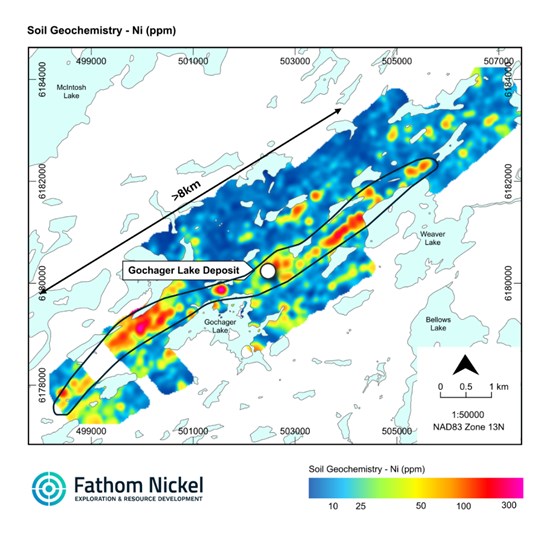
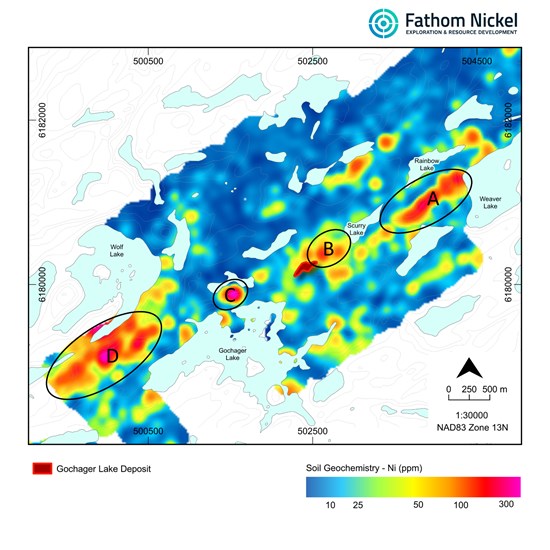
Comments on Figures 1 and 2:

  • Figure 1 emphasises the >8km trend defined by Ni in-soil geochemical anomaly(s). The Ni in-soil anomalous trend is also supported with anomalous to very anomalous Cu, Co in-soil, along with anomalous to very anomalous Mg and Cr. Mg and Cr are key pathfinder elements and indicators of subsurface mafic-ultramafic rock; the Gochager Lake deposit ‘Container Rock’. The east-northeast trend coincides with mineralized variable-texture gabbro mapped in outcrop up to 3.5km along trend of the deposit. Mineralized variable-texture gabbro at the deposit hosts the steeply oriented, high-grade chutes and lenses of Ni-Cu-Co semi-massive to massive sulphide mineralization intersected by Fathom drilling.
  • Figure 2 illustrates initial drill target priority areas:
    • Area A – The Camp anomaly is defined by the >900m long multi-element soil geochemical anomaly and associated with mapped outcrops of variable-texture gabbro and mafic to ultramafic rock. Elevated Cu, coincident with elevated Ni in rock samples, strongly indicates control by magmatic sulphide processes. A mapped and sampled outcrop occurring between Scurry and Rainbow Lakes that mimics the deposit stratigraphy and, specifically, mineralized variable-texture gabbro, has a Ni-tenor of 4.51% Ni* (Fathom Press Release January 28, 2026). Furthermore, rock grab samples collected in this area returned anomalous Pt values (40-60ppb), and Pd values (20-30ppb).
    • Area B – Gochager East Extension Anomalies cover the >500m distance along strike east-northeast of the Gochager Lake deposit to the shore of Scurry Lake. Within this area, the soil anomalies exhibit a stronger response than the Gochager deposit. EM anomalies, defined by surface geophysical surveys remain untested, and off-hole BHEM anomalies from drillhole GL23011 remain untested. Mapped geology confirms the extension of mineralized variable-texture gabbro, and Ni-tenors up to 5% Ni* in outcrop have been recorded. Coincident with elevated Ni in outcrop, elevated Cu is prominent which strongly suggests a magmatic sulphide control.
    • Area C – The North Gochager Lake Anomaly defines the highest Ni in-soil geochemical anomaly observed to date (1650 ppm Ni, 116.5ppm Cu, 373ppm Co). Rock samples collected (grab, and pXRF chip samples) at this anomaly returned elevated Ni, Cu, Cu but in a non-mafic to ultramafic rock type. Drilling here is designed to better understand the geology and to ascertain a possible subsurface, mineralized mafic-ultramafic body as the source of the multi-element soil geochemical anomaly.
    • Area D – The Wolf Lake Anomaly is a standalone multi-element (Ni, Cu, Co, Mg, Cr) soil anomaly measuring 1500m x 400m (note: the anomaly not fully defined due to the gap in data caused by the 2025 wildfire). Drilling in this area is designed to gain an understanding of the underlying geology. An initial understanding of the Wolf Lake Anomaly will impact follow-up summer field activities and surface geophysics in the area. It is unlikely that this target will be tested during the winter drilling campaign due to logistical and time constraints.

*Ni-tenor is the quantity of nickel contained within the sulphide component of the rock. At the Gochager Lake deposit, various styles of sulphide mineralization in gabbroic and ultramafic rock demonstrate Ni-tenors ranging from 2% to 5%. Ni-tenor is the percentage of nickel in sulphide only and is reported as the weight percent nickel in 100% sulphide. Fathom only reports Ni-tenor calculations in drill core and rock assay samples where assays report ≥1% sulphur. Calculations on samples below 1% sulphur tend to be inaccurate with respect to contained nickel in the sulphide component.
Cannot view this image? Visit: https://legacyinsidershub.com/wp-content/uploads/2026/02/285052_a74673f88416797c_002.jpg

Figure 1 – Gochager Lake Deposit Hosted in >8km Multi-Element Soil Geochemistry Trend

To view an enhanced version of this graphic, please visit:
https://images.newsfilecorp.com/files/7843/285052_a74673f88416797c_002full.jpg
Cannot view this image? Visit: https://legacyinsidershub.com/wp-content/uploads/2026/02/285052_a74673f88416797c_003.jpg

Figure 2 – Drill Target Areas

To view an enhanced version of this graphic, please visit:
https://images.newsfilecorp.com/files/7843/285052_a74673f88416797c_003full.jpg

Quality Assurance / Quality Control (QA/QC) Disclosure Statement

As part of its ongoing exploration activities, Fathom is utilizing a portable Vanta™ XRF Analyzer (‘pXRF’) to provide real-time lithogeochemical, multi-element data on surface rock chip samples and rock grab samples collected in the field. The Vanta™ XRF Analyzer is a hand-held device, held in position for a total 120 seconds – beam 1 (30 seconds), beam 2 (60 seconds) and beam 3 (30 seconds) to allow for an effective reading of elements occurring at that specific point, and at that specific surface of a rock sample. All elements detected at that specific point; nickel, copper, cobalt plus key pathfinder elements, chrome and magnesium, are recorded. The reader is cautioned that pXRF data should be treated only as an indication of elements, as the accuracy of the beam position on a particular element is variable.

Qualified Person and Data Verification

Ian Fraser, P.Geo., CEO, VP Exploration and a Director of the Company and the ‘qualified person’ as such term is defined by National Instrument 43-101, has verified the data disclosed in this news release, and has otherwise reviewed and approved the technical information in this news release on behalf of the Company.

About Fathom Nickel Inc.

Fathom is an exploration company that is targeting magmatic nickel sulphide discoveries to secure the supply of North American Critical Minerals and to support the global green energy transition. The Company now has a portfolio of three high-quality exploration projects located in the prolific Trans Hudson Corridor in Saskatchewan:

1) The Albert Lake Project, a 90,000+ hectare project that hosts the historic Rottenstone Mine1. Fathom exploration to date at the Albert Lake project confirms:

  • The high-grade Ni-Cu-Co+3E1 Rottenstone deposit mineralization extends to the south a minimum 40m and remains open.
  • The Rottenstone deposit is potentially offset and continues within the footwall of a prominent fault defined by drilling.
  • A new Rottenstone-like discovery (similar host rock, and similar mineralization) by drilling 500-550m W-NW of the historic mine; the 300+m Bay Island Trend, remains open along strike.
  • Similar Rottenstone-like host rock and mineralization intersected by drilling approximately 1.5km S-SW of the historic mine (the Nic5-Tremblay-Olson area).

2) The 33,000+ hectare Gochager Lake Project that hosts the historic Gochager Lake deposit2. Fathom exploration to date at the Gochager Lake project confirms:

  • Vertical extension of Ni-Cu-Co mineralization a minimum of 150m below the historic Gochager Lake deposit interpreted boundary, and very good potential for expansion of mineralization in all directions.
  • Multiple high-grade vertically oriented Ni-Cu-Co sulphide breccia mineralization zones and chutes occur within the historic deposit, and the zones, chutes remain open for further expansion and delineation in all directions.
  • Surface mapping and rock geochemistry has confirmed the Gochager Lake deposit host/container rock extends 3.5+ km along strike east-northeast of the deposit.
  • Soil geochemistry has defined a favourable geochemical footprint, inclusive of the historic deposit, that now extends 8.6+ km.

3) The 10,000+ hectare Friesen Lake Project located 40km southwest of the historic Rottenstone Mine and 30km northwest of the historic Gochager Lake deposit.

The Friesen Lake property hosts the Olsen Cu-Ni-Pt Showing also referred to as the Friesen Lake Cu-Ni-Pt showing and is described as an ultramafic dyke that historic trenching and drilling demonstrates Cu-Ni-Pt-Pd and Au mineralization within the ultramafic dyke (Saskatchewan Mineral Deposit Index (SMID) #0928a). To date Fathom has not performed any exploration at the Friesen Lake Project.

1 – The Rottenstone Mine; a small open-pit mining / milling operation was in production 1965-1969. Mining in 1965 produced 5,500 short tons with a reported average production grade of 3.23% Ni, 1.83% Cu, 0.14 oz/ton Pt, 0.10 oz/ton Pd, 0.03 oz/ton Au (9.26 g/t*3E, 3E = Pd-Pt+Au) and 0.20 oz/ton Ag. Initial milling of mine concentrate; September 5 – November 7, 1965, produced 1,070 dry short tons of concentrate that averaged 10.83% Ni, 5.74% Cu, 0.33 oz/ton Pt, 0.53 oz/ton Pd, 0.10 oz/ ton Au (32.91 g/t* 3E) and 1.25 oz/ton Ag. Richards, B.R. and Robinson, B.G.W. (1966), Mining and milling a small ore deposit …. Rottenstone Mining Limited: The Canadian Mining and Metallurgical Bulleting for December 1966. The Saskatchewan Mineral Deposit Index (SMDI) #0958 reports final mine production in 1969 of 28,724 tons with an average grade of 3.28% Ni, 1.83% Cu and 9.63 g/t 3E and that approximately 9,000 tons of concentrate were sold to the International Nickel Company of Canada Limited. * A factor of 34.286 g/tonne was used to convert 1 oz/ton to g/tonne (g/t).

2 – The Gochager Lake property is host to the historic Gochager Lake Ni-Cu deposit. There is no source or available Technical Reports to verify the historic resource estimate for the Gochager Lake deposit; hence, Fathom will treat the historic estimate as an Exploration Target. Available records in the Saskatchewan Mineral Deposit Index (SMDI) and Saskatchewan Mineral Assessment Database (SMAD) suggest an Exploration Target of 4-5 million tons grading 0.3% Ni – 0.4% Ni and 0.08% Cu – 0.09% Cu. The potential quantity and grade are conceptual in nature, there has been insufficient exploration to define a mineral resource, and that it is uncertain if further exploration will result in the target being delineated as a mineral resource. At present, Fathom has drilled 16 drillholes (5,549m) into the historic Gochager Lake deposit and has confirmed Ni-Cu grades comparable to and higher than the historical grades reported, thus confirming that a deposit of Ni-Cu+Co metal accumulation does exist at the historic Gochager Lake deposit / property. The disclosed potential quantity and grade has been determined by historic records notably; the Saskatchewan Mineral Deposit Index and Saskatchewan Mineral Assessment Database. (SMDI #0880) reports delineation drilling outlined a deposit at the historic Gochager Lake Deposit; Steel, J.S. (1990), (SMAD 73P15-0091): Report on a Diamond Drilling Program on the Gallagher (Gochager) Lake Property of McNickel Inc., reported that Scurry-Rainbow Oil Ltd. constructed vertical sections and a longitudinal section from drill data collected 1966-1968, and an orebody with reasonably well-defined limits was interpreted. As stated above, the historic estimate is not well documented and there are no available Technical Reports to support the historic resource estimate(s).

For further information, please contact:

Ian Fraser, Chief Executive Officer & Vice-President Exploration
1-403-650-9760
Email: ifraser@fathomnickel.com

or

Doug Porter, President & CFO
1-403-870-4349
Email: dporter@fathomnickel.com

Forward-Looking Statements:

This news release contains ‘forward-looking statements’ that are based on expectations, estimates, projections and interpretations as at the date of this news release. Forward-looking statements are frequently characterized by words such as ‘plan’, ‘expect’, ‘project’, ‘seek’, ‘intend’, ‘believe’, ‘anticipate’, ‘estimate’, ‘suggest’, ‘indicate’ and other similar words or statements that certain events or conditions ‘may’ or ‘will’ occur, and include, without limitation, statements regarding completion of the Offering, price of the FT Units, Charity FT Units and HD Units, dates for closing of the Offering, amount of proceeds under the Offering, approval of the Offering by regulatory authorities, payment of commissions and finder warrants to finders and the Company incurring Qualifying Expenditures. Forward-looking statements relate to information that is based on assumptions of management, forecasts of future results, and estimates of amounts not yet determinable. Any statements that express predictions, expectations, beliefs, plans, projections, objectives, assumptions or future events or performance are not statements of historical fact and may be ‘forward-looking statements.’ Forward-looking statements are subject to a variety of risks and uncertainties which could cause actual events or results to differ from those reflected in the forward-looking statements, including, without limitation: risks related to failure to obtain adequate financing on a timely basis and on acceptable terms; risks related to the outcome of legal proceedings; political and regulatory risks associated with mining and exploration; risks related to the maintenance of stock exchange listings; risks related to environmental regulation and liability; the potential for delays in exploration or development activities or the completion of feasibility studies; the uncertainty of profitability; risks and uncertainties relating to the interpretation of drill results, the geology, grade and continuity of mineral deposits; risks related to the inherent uncertainty of production and cost estimates and the potential for unexpected costs and expenses; results of prefeasibility and feasibility studies, and the possibility that future exploration, development or mining results will not be consistent with the Company’s expectations; risks related to commodity price fluctuations; and other risks and uncertainties related to the Company’s prospects, properties and business detailed elsewhere in the Company’s disclosure record. Such forward-looking statements involve known and unknown risks, uncertainties and other factors which may cause the actual results, performance or achievements of the Company to be materially different from any future results, performance or achievements expressed or implied by such forward-looking statements. These forward-looking statements are made as of the date hereof and the Company does not assume any obligation to update or revise them to reflect new events or circumstances except in accordance with applicable securities laws. Actual events or results could differ materially from the Company’s expectations or projections.

Source

This post appeared first on investingnews.com